


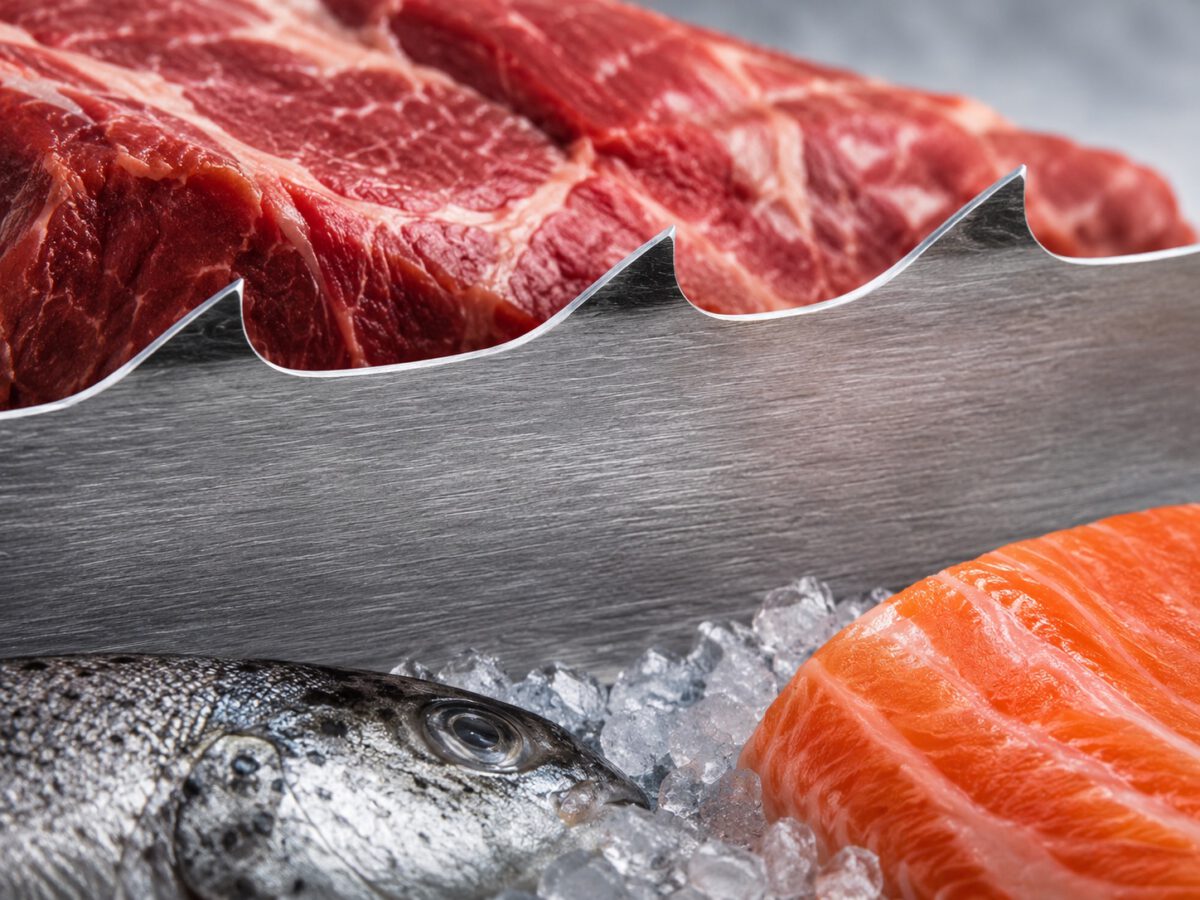
Although both are used in the food industry, band saws for meat and fish are designed to meet different cutting requirements. Choosing the right blade has a direct impact on cut quality, product waste and line productivity.
What is the difference between a meat saw and a fish saw?
The main difference lies in the characteristics of the product.
Meat tends to have denser fibres and, in many cases, bones, which require the blade to be more robust. Fish, on the other hand, is a more delicate product that requires precise, clean cuts to minimise wastage and improve the final presentation.
Bandsaws for meat
Bandsaws for meat are designed to cut fresh or frozen products, whether boned or bone-in.
Most common settings
3 TPI: Suitable for cutting frozen meat, both bone-in and boneless. The larger tooth size facilitates the removal of debris and allows for optimized cutting speed.
4 TPI: Suitable for cutting bones and fresh meat, whether bone-in or boneless. It provides a clean cut and is primarily used in machines with linear speeds below 20 m/s.
CTooth: Reduces debris buildup, minimizes vibrations, and improves the appearance of the cut.
Bandsaws for fish
Band saws for fish are designed to maximise precision and minimise waste.
Most commonly used configurations
3 TPI: This is the most common configuration for cutting frozen fish in general. Its larger tooth size facilitates the removal of debris and optimizes cutting speed. There are different specifications available, including a stainless steel version for applications requiring maximum hygiene.
DB Bevel: Another common configuration, particularly suited for cutting, filleting, and skinning fresh fish and cephalopods. It minimizes waste and produces a clean, residue-free cut.
How to choose the right saw?
Before selecting a band saw, it is advisable to consider:
- Type of product.
- Presence of bones or bones.
- Operating temperature.
- Required finish quality.
- Production level.
A blade specifically designed for each application helps to improve productivity and extend the saw’s service life.
If you work mainly with meat products, we recommend consulting our guide on how to choose a bandsaw for meat, in which we analyse the different types of teeth and applications depending on the species and the type of cut.
On the other hand, for applications involving fresh, frozen or deep-frozen fish, you can find further information in our article on how to choose a bandsaw for fish, which includes specific recommendations depending on the species and the production process.
Conclusion: Bandsaws for meat and fish cater to different cutting requirements. Whilst for meat, resistance to bones and productivity are the key considerations, for fish the priorities are precision, surface finish and minimising waste.
Choosing the right tooth configuration improves the quality of the final product, extends the saw’s service life and optimises the performance of the entire production line.
Do you need advice on choosing the most suitable band saw for your meat or fish processing operations? At MESI Saws & Blades, we can help you choose the cutting solution that best suits your product, machinery and production volume.